Sleep apnea is one of the most common conditions veterans claim, and one of the most commonly denied. The usual reason is simple: most veterans were never diagnosed while they were in uniform, so a direct claim has nothing in the service record to point to. For many of them, the stronger path is a secondary claim: showing that a condition VA has already service connected, such as PTSD, caused or worsened the sleep apnea.
Sleep apnea is rated under Diagnostic Code 6847 in 38 CFR § 4.97. As of this writing, every claim is still decided under these criteria:
| Rating | Current criteria (DC 6847) |
|---|---|
| 100% | Chronic respiratory failure with carbon dioxide retention or cor pulmonale, or requires a tracheostomy |
| 50% | Requires use of a breathing assistance device such as a CPAP machine |
| 30% | Persistent daytime hypersomnolence |
| 0% | Asymptomatic but with a documented sleep disorder breathing |
About the proposed rating change: in February 2022 VA proposed rating sleep apnea by how well treatment works rather than by whether a CPAP is prescribed. As of late September 2026 that rule has not been finalized, and VA has told reporters it needs significant changes first. A change to the rating schedule does not automatically reduce an existing rating. If you're weighing whether to file, talk timing through with your representative.
Research on post-9/11 veterans has found that those with PTSD screen at high risk for obstructive sleep apnea far more often than you'd expect, and the relationship is an active area of study. The medical reasoning in a secondary opinion usually draws on some combination of these:
PTSD isn't the only possible link. Chronic rhinitis or sinusitis, and long-term opioid therapy for a service-connected pain condition, can also be part of the picture, depending on the record. Our secondary & associated conditions page covers more of these connections.
The opinion is where most secondary sleep apnea claims are won or lost. A one-line conclusion carries little weight. An opinion that walks through the mechanism, addresses both causation and aggravation, and deals honestly with other risk factors is the kind a rater can rely on. Here's what makes a Nexus Letter hold up.
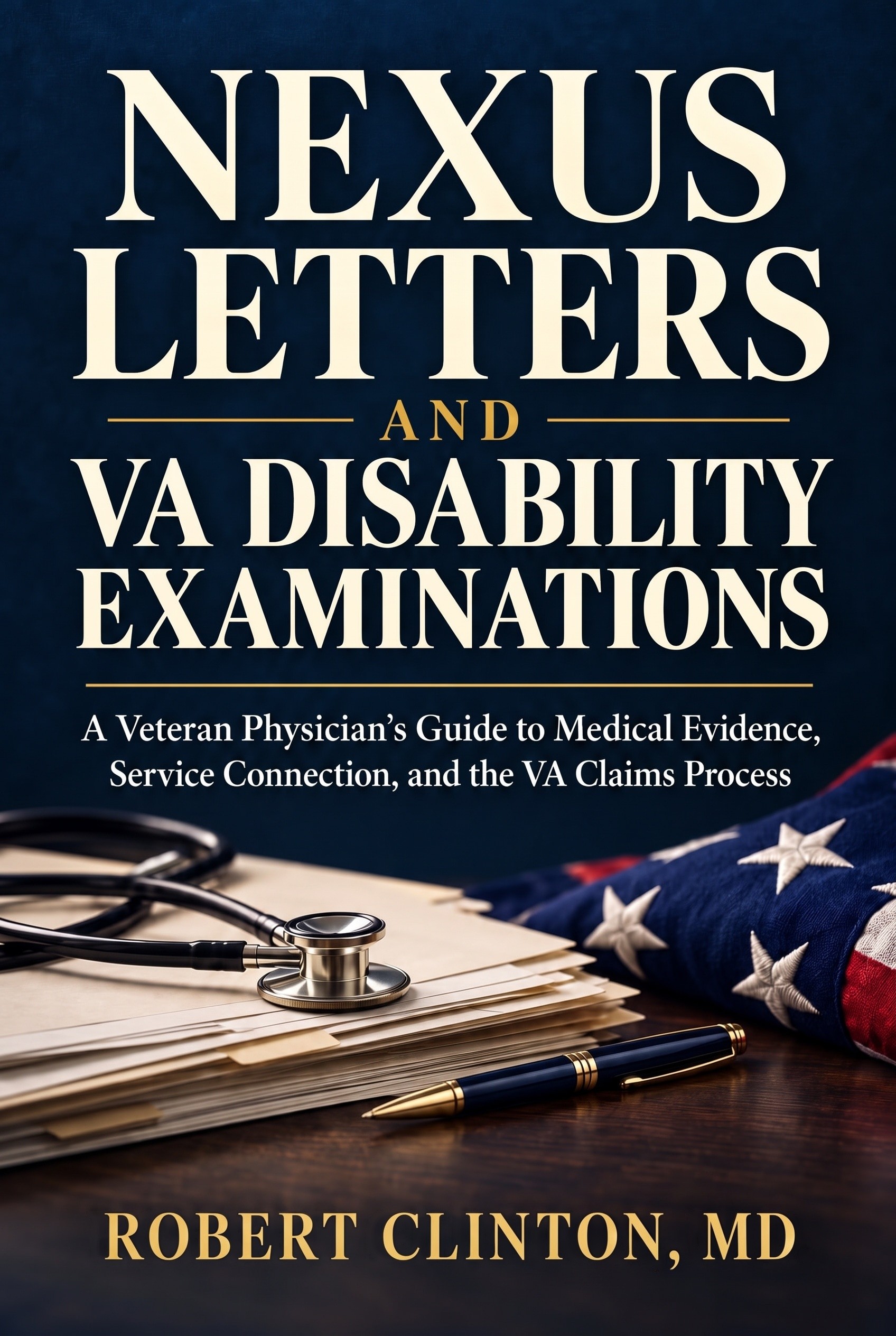
The book
Nexus Letters and VA Disability Examinations
Dr. Clinton's guide to medical evidence, service connection and the VA claims process. Paperback, linen hardcover and ebook.
Get the book
Dr. Robert Clinton is a former Army physician at Fort Bragg and a 100% service-connected disabled veteran. Since 2011 he has performed or taken part in more than 30,000 VA disability exams and DBQs. More about Dr. Clinton
This article is general information, not medical or legal advice. Every claim depends on its own record.
Call (910) 830-1587 (24/7) or email info@nexusready.net.
 NEXUS