
Migraines are one of the conditions where the rating most often fails to match the veteran's reality. The criteria turn on a single word that isn't defined in the regulation, and the evidence that proves it usually has to come from the veteran. Knowing how VA reads the rule makes a real difference.
Migraines are rated under Diagnostic Code 8100 in 38 CFR § 4.124a:
| Rating | Criteria (DC 8100) |
|---|---|
| 50% | Very frequent, completely prostrating and prolonged attacks productive of severe economic inadaptability |
| 30% | Characteristic prostrating attacks occurring on an average once a month over the last several months |
| 10% | Characteristic prostrating attacks averaging one in 2 months over the last several months |
| 0% | Less frequent attacks |
The regulation doesn't define it. In practice, VA and the Board generally treat a prostrating attack as one that forces you to stop what you're doing and lie down or withdraw, often in a dark, quiet room, until it passes. A headache you can push through at your desk usually isn't counted. One that sends you home, keeps you in bed, or requires you to stop driving usually is.
The 50% level trips up many veterans. The Court of Appeals for Veterans Claims has held that “productive of severe economic inadaptability” does not require that you be unable to work. Attacks that are capable of producing severe economic inadaptability can qualify, so missed shifts, leaving early and lost productivity all matter.
Keep a headache log. For each attack, note the date, how long it lasted, whether you had to lie down, what you took, and what you missed: work, driving, family time. Three to six months of honest entries is often the strongest evidence in a migraine claim, because it shows the pattern the rating criteria ask about.
Migraines are frequently secondary to another service-connected condition. Depending on the record, the medical reasoning can involve:
Headaches after a traumatic brain injury are evaluated with the TBI rules, and a good opinion addresses which framework applies. As with any secondary claim, the opinion should address both causation and aggravation. See how secondary service connection works.
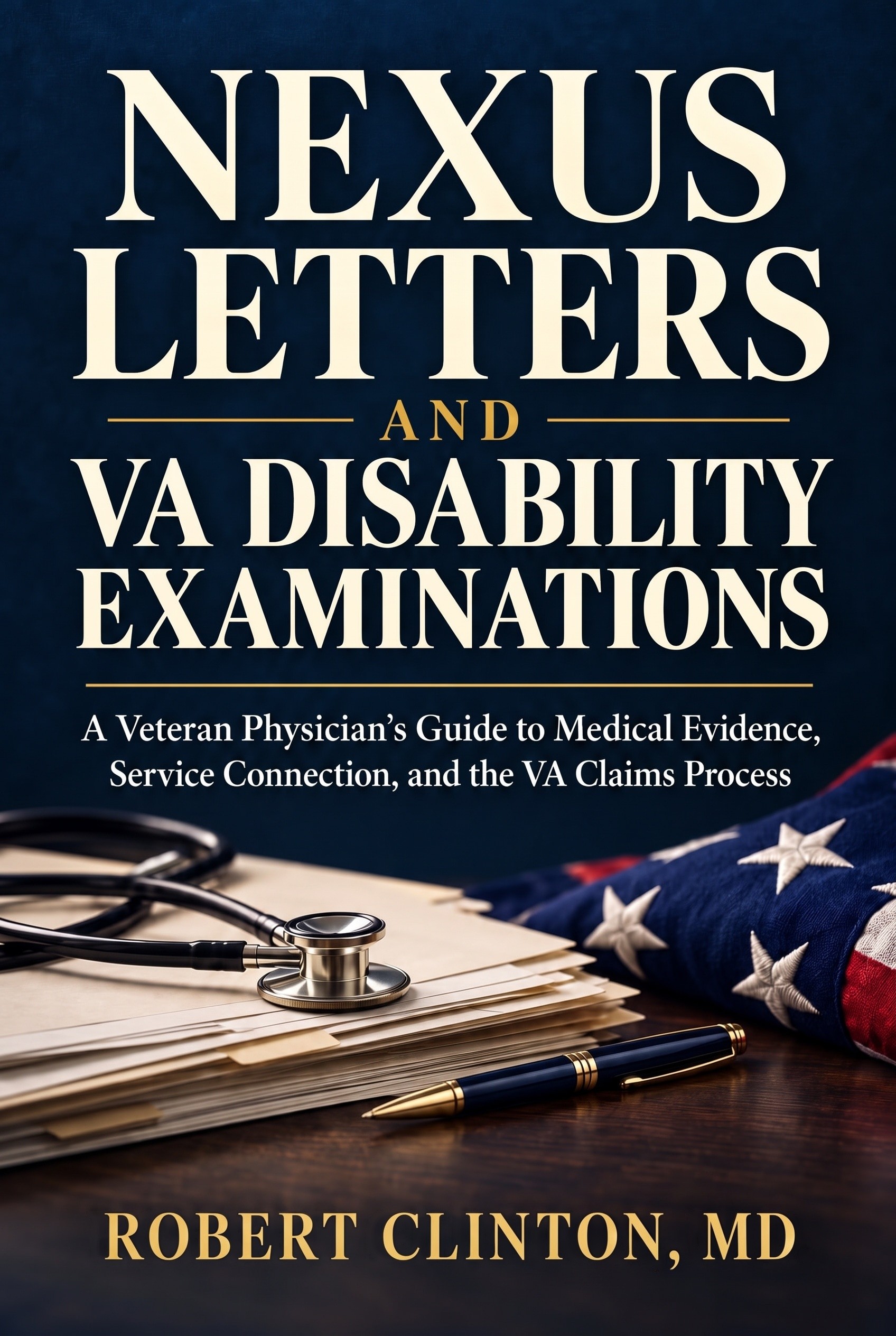
The book
Nexus Letters and VA Disability Examinations
Dr. Clinton's guide to medical evidence, service connection and the VA claims process. Paperback, linen hardcover and ebook.
Get the book
Dr. Robert Clinton is a former Army physician at Fort Bragg and a 100% service-connected disabled veteran. Since 2011 he has performed or taken part in more than 30,000 VA disability exams and DBQs. More about Dr. Clinton
This article is general information, not medical or legal advice. Every claim depends on its own record.
Call (910) 830-1587 (24/7) or email info@nexusready.net.
 NEXUS